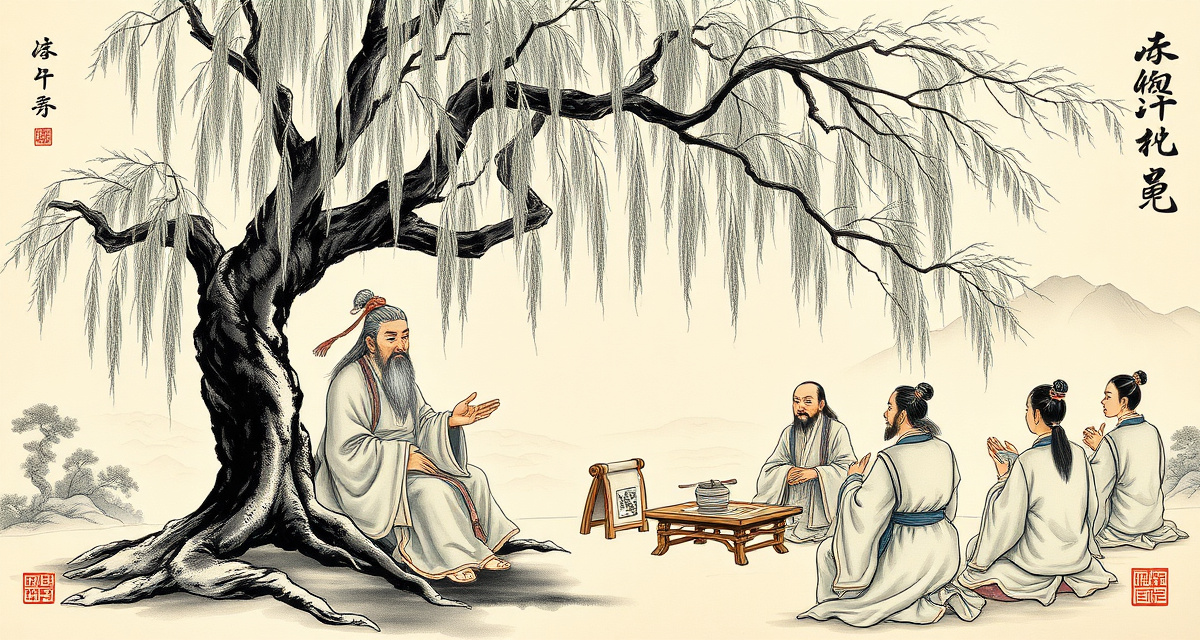
In the Analects, Confucius's disciple Zilu asks his teacher a practical question. If a ruler called on you to govern, what would you do first?
The answer, in Book XIII, is famous and strange. Confucius does not say "establish justice" or "restore the economy" or "strengthen the military." He says: "It would certainly be to rectify the names."
Zilu cannot believe it. "That?" he says. "How is that to the point?"
Confucius scolds him. "How uncultivated you are! With regard to what he does not understand, the gentleman maintains an attitude of reserve."
Then comes one of the most quoted passages in Chinese philosophy:
"If names are not rectified, then language will not be in accord with truth. If language is not in accord with truth, then affairs cannot be carried out successfully. When affairs cannot be carried out successfully, ritual and music will not flourish. When ritual and music do not flourish, punishments will not be just. When punishments are not just, the people will not know where to put hand and foot. Therefore the gentleman uses only such language as is proper for his position, and acts only on what he can speak about." — Analects 13.3
For Confucius, the entire moral and political order depends on getting one thing right: the relationship between what we say and what is the case. The Chinese phrase is 正名 — zhèng míng, the rectification of names — and it has shaped twenty-five hundred years of East Asian thought.
It also has more to teach the modern reader than its archaic surface might suggest.
What Confucius Actually Meant
The doctrine of the rectification of names operates on at least three levels.
First, it concerns the alignment of words with reality. A father should be a father — not in name only, but in the substance of fatherhood. A ruler should rule, not merely occupy the throne. A friend should be friendly. The word should match what it claims to describe. When society lets the word drift loose from the reality, language becomes a tool of deception, and deception corrodes everything it touches.
Second, it concerns role and responsibility. In Confucian thought, every social role carries a set of obligations. To be called minister is to be responsible for ministering. To be called teacher is to be responsible for teaching. The rectification of names is, in part, the insistence that titles and duties go together — that you cannot accept the prestige of a role while abandoning its substance.
Third, it concerns the conditions for shared life. When the ruler is called ruler but rules only for personal benefit, when the teacher is called teacher but teaches only for status, when the friend is called friend but acts only out of self-interest, social trust collapses. Words lose their grip. People stop knowing what to expect from one another. As Confucius puts it: "The people will not know where to put hand and foot."
A Test for Honest Speech
The rectification of names is a strikingly practical doctrine. It functions as a kind of ethical test. Take any word you use about yourself, your community, or your work, and ask: does the substance match the name?
If you call yourself a Christian, does the substance of Christ's teaching shape your daily life?
If your government calls itself democratic, do the actions of the government honor the will of the governed?
If your company describes itself as customer-focused, do the operating practices reward those who serve customers, or those who exploit them?
If your relationship is called love, does it bear the fruit of love — patience, kindness, the absence of envy and pride — or only the word?
When a name has come loose from its reality, Confucius is saying, three things follow. The world becomes harder to navigate, because language no longer tracks what is. Trust erodes, because people learn that words can be hollow. And, eventually, even the just are punished and the unjust prosper, because the categories we use to assign praise and blame no longer correspond to anything real.
Why This Was Radical
To grasp why this teaching mattered in fifth-century BC China, picture the political moment. Confucius lived during the late Spring and Autumn period, an era when the old aristocratic order was breaking down. Lords were claiming the title of king without the moral authority of kings. Ministers were assassinating rulers and continuing to call themselves ministers. The old vocabulary of legitimate authority was being applied to power that had nothing to do with what those words had meant.
In that context, zhèng míng was a quiet revolution. It refused to grant the legitimacy that words ordinarily confer. It said, in effect: you may call yourself a duke, but if you do not rule justly, you are not truly a duke — you are a man with a title. The title is owed to the substance, not the substance to the title.
The doctrine also undergirded Confucius's lifelong insistence on ritual (li). Rituals are formalized actions that train people in their proper roles — they are the visible discipline by which names and realities are kept aligned. To bow to a parent is to practice being a child. To extend hospitality to a guest is to practice being a host. Ritual, for Confucius, is what keeps language and life from drifting apart.
What It Asks of You
The modern reader can take from the rectification of names at least three challenges.
Audit your own words. Notice the labels you wear and the labels you give to others. For each one, ask: am I living up to what this word means? Am I asking others to live up to what their words mean? Or have I let the words become decorative — useful for status, useless for shaping reality?
Refuse euphemism. Every age develops a set of phrases designed to make uncomfortable realities sound acceptable. Restructuring for layoffs. Friendly fire for accidental killing. Engagement for relationships that no one is actually building. Confucius would name these as failures of zhèng míng — the failure that makes "punishments unjust" because the categories themselves have been corrupted.
Demand the substance behind the title. Whether in leaders, institutions, or yourself, do not let the name do the work of the reality. To be called a thing is not yet to be it. The first task of a serious life is to make the name and the substance match.
This is a teaching with bite. Most ethical traditions agree about the importance of honesty. Confucius is saying something more specific: that linguistic honesty — the discipline of letting your words mean what they say and your roles match what you do — is not a small virtue. It is the soil in which all other virtues grow.
When the names are right, the world becomes navigable. When the names are wrong, no policy or technique can save us. The work of governance, of community, of any shared life, begins with the simplest and most demanding question:
Do my words say what is so?