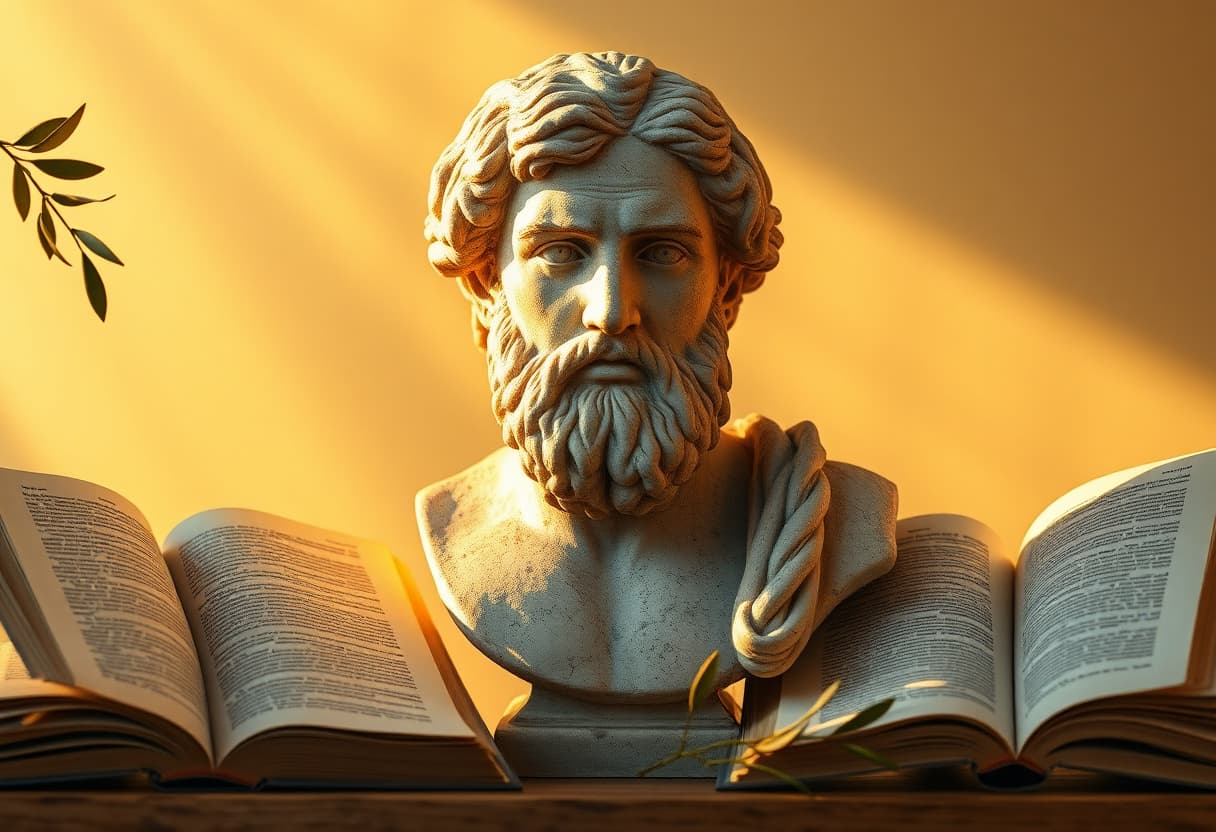
The question "what is the good life?" is the organizing question of ancient ethics. Before philosophy became primarily academic — before it focused mainly on epistemology and logic — it was centered on this practical problem: what kind of life should a person live?
The Greek word eudaimonia — often translated as "happiness" — captures the target. But "happiness" in contemporary usage usually means a pleasant emotional state, something like subjective wellbeing. Eudaimonia meant something more objective and more demanding: a life that is genuinely going well, that is flourishing in the way proper to human beings. You could, on the ancient view, think you were happy while not being eudaimon — your subjective sense of wellbeing could be mistaken or shallow.
Aristotle's Answer
Aristotle's account of eudaimonia in the Nicomachean Ethics is the most developed and influential in the tradition. His starting point is teleological: everything has a function, and the good of a thing consists in performing that function well. A good knife cuts well; a good eye sees well; a good human being lives well in the distinctively human way.
What is the distinctively human function? Aristotle argues it is the exercise of the rational faculty in accordance with virtue — not just having virtuous dispositions, but actively expressing them in a life of action. Eudaimonia is an activity, not a state.
The virtues Aristotle identifies are character traits that represent the mean between two extremes: courage is the mean between cowardice and recklessness; generosity between miserliness and prodigality; proper pride between servility and arrogance. Virtue is not a rule but a disposition — a cultivated tendency to perceive situations accurately and respond to them appropriately.
Aristotle's eudaimonia is not the life you enjoy but the life you become capable of living through the development of character.
This account has several important implications. First, eudaimonia requires time — it is not something you can have all at once but something that characterizes a whole life. Second, it requires the right kind of circumstances. Aristotle was honest enough to acknowledge that extreme poverty, illness, or the death of loved ones can genuinely undermine flourishing — not just feel bad, but actually make a fully flourishing life impossible. External goods matter.
Third, the virtues require practice. You become courageous by doing courageous things. You become just by performing just acts, and in doing so you form the habits and perceptions that make just action natural. Character is not given; it is made.
Epicurean and Stoic Alternatives
Aristotle's account was not the only ancient answer. The Epicureans and Stoics each offered competing visions.
Epicurus argued that eudaimonia consists in ataraxia — tranquility, freedom from disturbance — and aponia — freedom from bodily pain. The pleasures worth pursuing are not intense sensory pleasures (which tend to produce anxiety and dependence) but the quiet pleasures of friendship, philosophical reflection, and freedom from fear — especially the fear of death and divine punishment. Epicurean philosophy was fundamentally therapeutic: it aimed to cure the anxieties that prevent human beings from living peacefully.
The Stoics took the most radical position: eudaimonia consists entirely in virtue. External goods — health, wealth, reputation, even life itself — are "preferred indifferents." They're worth having if you can get them, but they are not components of the good life, only virtue is. This means that the wise person can be fully flourishing on the rack. Whether this is an inspiring vision of resilience or an impossible ideal remains contested.
What the Debate Still Offers
The ancient debate about eudaimonia remains relevant partly because it forces questions contemporary culture tends to avoid. Our prevailing implicit theory of the good life is hedonistic: more pleasure, less pain, more positive emotion, less negative. Life goes well when you feel good.
The ancients thought this was a confusion — that the question is not "am I happy?" but "am I living in a way that is genuinely good?" — and that these questions, while related, can and do come apart. The person who pursues pleasure single-mindedly often fails to flourish. The person who develops genuine virtue, maintains deep friendships, exercises practical wisdom in their work, and acts according to their best understanding of what is right — this person may or may not feel particularly good on any given day, but their life is going well in a way that matters.
This is a more demanding vision than contemporary happiness-maximization. It is also, arguably, a more interesting one — and one that better explains why many people feel that their lives are missing something despite satisfying every preference they can identify.
¹ Aristotle — Nicomachean Ethics (trans. Terence Irwin, 1999, Hackett Publishing) ² Alasdair MacIntyre — After Virtue (1981/2007, University of Notre Dame Press) ³ Julia Annas — Intelligent Virtue (2011, Oxford University Press)