On September 14, 2015, at 9:50:45 Universal Time, a faint vibration passed through planet Earth. It stretched space itself by a fraction smaller than the width of a single proton — roughly one ten-thousandth the width of an atomic nucleus. No human felt it. No instrument on the planet, save two, could have noticed.
But two instruments did notice. They were the twin detectors of the Laser Interferometer Gravitational-Wave Observatory, or LIGO. And in that microscopic stretch, they confirmed something Albert Einstein had predicted a century earlier — and had privately worried we might never actually see.
Gravitational waves are real. Spacetime, it turns out, ripples.
What Einstein Predicted
In 1915, Einstein completed his general theory of relativity. At its core was a radical new picture of gravity. Newton had described gravity as a force that mysteriously acted at a distance between masses. Einstein replaced this with geometry. Mass and energy curve the fabric of spacetime, and what we experience as gravity is just objects following the natural paths through that curved geometry.
Within a year, Einstein realized his equations implied something strange. If mass can curve spacetime, then a massive object that is accelerating — not moving uniformly, but speeding up, slowing down, or changing direction — should cause ripples in spacetime itself to propagate outward. These ripples would travel at the speed of light. They would stretch space in one direction and squeeze it in the perpendicular direction as they passed.
He called them Gravitationswellen — gravitational waves.
He also calculated how faint they would be. The problem was obvious: gravity is, by far, the weakest of the four fundamental forces. A gravitational wave strong enough to detect on Earth would require cataclysmic astrophysical events — colliding black holes, merging neutron stars — producing waves that still arrived on our planet almost infinitesimally small. Einstein himself at one point doubted whether they would ever be directly observed.
Why It Took 100 Years
For decades, the prediction sat mostly dormant. Physicists trusted general relativity for many reasons, but direct detection of gravitational waves was considered perhaps impossible. The engineering challenge was staggering.
Consider what was required. You needed to detect a stretch in space of about one ten-thousandth the diameter of a proton. Over a baseline of several kilometers. On a planet full of seismic noise, trucks, earthquakes, ocean waves, and students tapping their feet.
The solution, developed over fifty years by physicists including Rainer Weiss, Kip Thorne, and Barry Barish (who would share the 2017 Nobel Prize), was an enormous L-shaped laser interferometer. Light is split and sent down two perpendicular four-kilometer arms. It bounces off mirrors at the ends and returns. When the two beams recombine, their interference pattern reveals whether one arm became very slightly longer or shorter than the other — exactly what a passing gravitational wave would cause.
Two identical detectors were built, one in Livingston, Louisiana, and one in Hanford, Washington, roughly 3,000 kilometers apart. Real gravitational waves would be detected at both, with a tiny time delay consistent with the speed of light. Local noise — a truck, an earthquake — would only show up at one.
It took decades of engineering, hundreds of millions of dollars, and an extraordinary international collaboration. The first full-scale operations began in 2002. For over a decade, LIGO detected nothing.
Then came September 14, 2015.
GW150914
The signal was named GW150914, for "gravitational wave" on that date. It lasted about two-tenths of a second. Its shape — a rising chirp in frequency — matched exactly the predicted signature of two black holes spiraling into each other and merging.
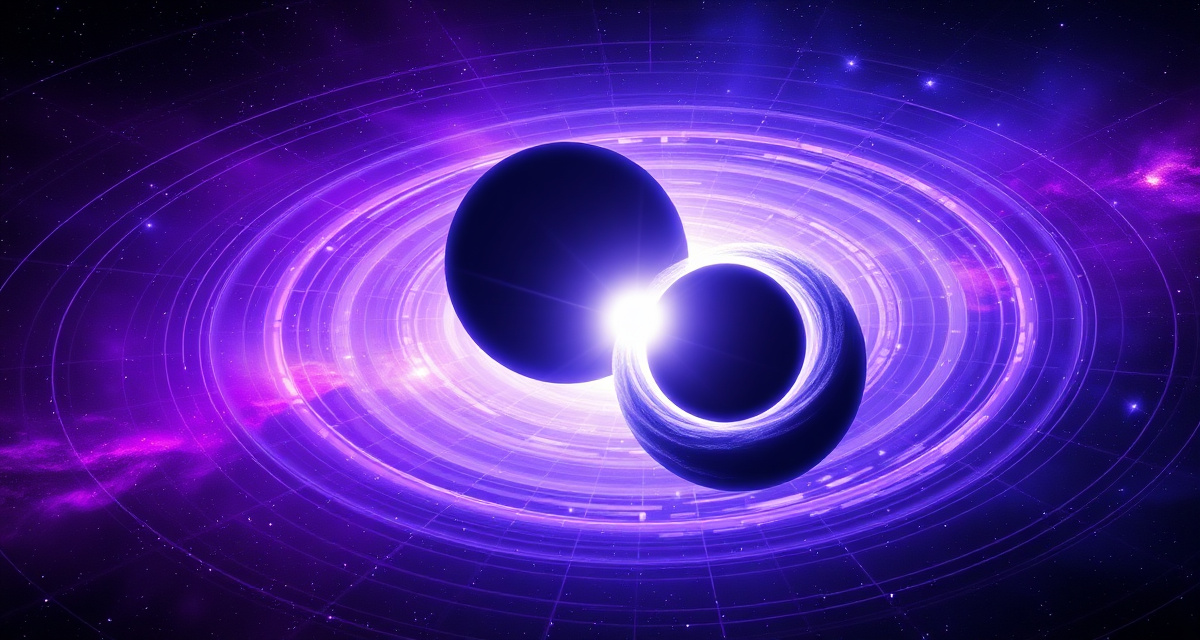
Analysis of the waveform allowed physicists to reconstruct the event. Two black holes, roughly 29 and 36 times the mass of the Sun, had collided about 1.3 billion light-years from Earth. In their final moments, they were orbiting each other at more than half the speed of light. The merger briefly produced more power than all the light from all the stars in the observable universe combined — released not as light, but as gravitational waves.
Three solar masses of material had been converted directly into ripples in spacetime, radiating outward. For 1.3 billion years, those ripples had been propagating through the cosmos. They reached Earth at 9:50:45 UT and stretched the LIGO detectors by a fraction that almost beggars description. And we caught them.
The discovery was announced on February 11, 2016. Weiss, Barish, and Thorne received the Nobel Prize in Physics the following year.
What We Have Learned Since
The first detection was revolutionary because it happened at all. But since then, LIGO (joined by Virgo in Italy and KAGRA in Japan) has detected dozens of additional gravitational-wave events — most from colliding black holes, a few from merging neutron stars.
The August 2017 detection of GW170817, a neutron-star merger, produced a spectacular companion event: astronomers, alerted by LIGO-Virgo, pointed telescopes at the predicted region of sky and caught the visible, infrared, and gamma-ray light from the collision. It was the first time humans had observed the same event in both gravitational waves and electromagnetic radiation — the birth of what is now called multi-messenger astronomy.
That single event taught us extraordinary things. It confirmed that neutron-star mergers are a major source of the universe's heavy elements — gold, platinum, uranium — produced in the ferocious conditions of the collision. It provided an independent measurement of the speed of gravity (identical to the speed of light, to within a tiny fraction of a percent). And it gave cosmologists a new, geometry-independent way of measuring the expansion rate of the universe.
Why This Matters Beyond Physics
Gravitational waves opened a new sense for humanity. For four hundred years, since Galileo first turned a telescope to the night sky, we had observed the universe almost entirely through light — visible, radio, X-ray, gamma-ray, but all electromagnetic. Now we can also hear the universe, in the sense that gravitational waves encode information that electromagnetic observations cannot capture.
Black-hole mergers, which are invisible to electromagnetic telescopes (black holes emit no light), were essentially undetectable to prior astronomy. Now we can census their populations. The earliest moments of the universe, opaque to light, may eventually become visible in gravitational waves — echoes from a time before there were any atoms at all to emit photons.
And the simple fact that Einstein's geometric theory of gravity, written in 1915, correctly predicted a phenomenon we only directly observed in 2015 — after a century of skepticism, engineering heroics, and patient waiting — is one of the more striking vindications in the history of science.
A Note on Patience
There is something moving about the LIGO story that has less to do with physics than with what humans are capable of when we commit to a hard question. The project took five decades from serious proposal to first detection. Many of the original advocates did not live to see the result. A generation of graduate students built their careers on detectors that detected nothing. Congress debated whether to keep funding it.
And then, one quiet September morning, 1.3 billion years after two black holes had spiraled into each other in a distant galaxy, their waves arrived. And because a stubborn coalition of scientists had kept building, checking, and refining, we were ready.
Einstein, who died in 1955, did not live to see gravitational waves directly confirmed. But his equations did. Which, in some sense, was the whole point.