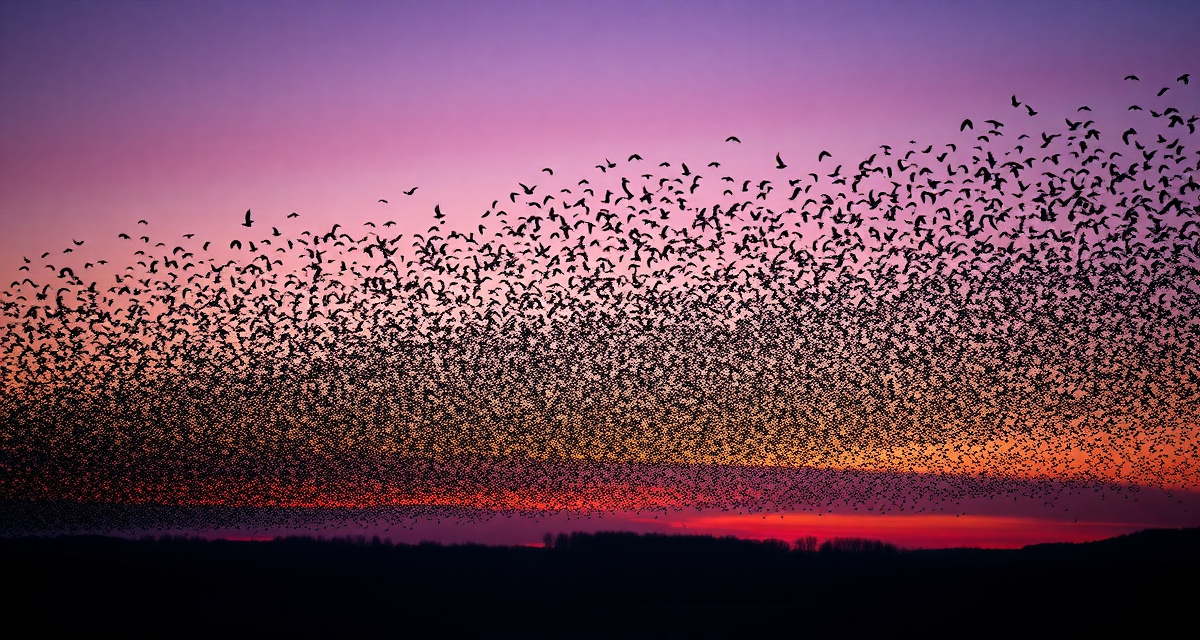
If you have ever watched a murmuration of starlings — tens of thousands of birds pouring through an autumn sky in shifting dark ribbons — you have witnessed one of the most visually striking phenomena in nature. The flock moves as one. It turns, folds, cascades, avoids predators, regroups — all without collisions and, apparently, without a leader.
How is this possible? For decades, biologists assumed some kind of mysterious "collective mind" was at work, or that one or two dominant birds must be steering the whole flock. The real answer, worked out by physicists and biologists over the last fifteen years, is stranger and more interesting. Each bird is following a startlingly simple rule about its neighbors — and the large-scale pattern is what naturally emerges.
What Is Actually Happening
A starling murmuration can contain hundreds of thousands of birds. Yet if you slow down high-speed footage, you can see that wave-like movements seem to sweep across the flock faster than any one bird could possibly fly. How?
In 2008, a research group called STARFLAG, based in Rome and led by physicist Andrea Cavagna and biologist Irene Giardina, used multi-camera stereo imaging to reconstruct the three-dimensional position and velocity of thousands of birds in real starling flocks over the city of Rome. Their results, published in the Proceedings of the National Academy of Sciences (2008) and subsequent papers, changed our understanding of how flocks work.
The STARFLAG team found two surprising things.
First, birds pay attention to a fixed number of neighbors, not a fixed distance. Each starling coordinates its movement with roughly six or seven of its nearest neighbors, regardless of how close or far those neighbors happen to be. This is called topological rather than metric interaction. If the flock stretches out, the interaction range stretches with it; if the flock compresses, the interaction range compresses. The number of monitored neighbors stays the same.
Second, information propagates through the flock at a speed that is not simply the product of individual reactions. Cavagna's group and others have shown that direction changes move through the flock in wave-like fashion. When a peregrine falcon dives in from one side, the response does not slowly ripple out bird by bird; it travels as a collective wave, physically analogous to waves in other complex systems like magnetized spins or superfluids.
The Underlying Rules
In 1987, computer animator Craig Reynolds created a simulation called Boids that showed three simple rules could generate flock-like behavior:
- Separation. Don't crowd your neighbors.
- Alignment. Steer toward the average heading of your neighbors.
- Cohesion. Move toward the average position of your neighbors.
Run those three rules on virtual agents in software, and you get flocking behavior that looks remarkably like a real starling murmuration — even though no agent knows anything about the group as a whole.
The STARFLAG work refined Reynolds's picture. Real starlings use something close to these three rules, but operating on a topological neighborhood of a fixed count rather than a fixed radius. This makes the flock surprisingly robust: it can change shape dramatically without ever breaking apart, because each bird's "social circle" moves with the density of the group.
Why It Matters Beyond Birds
Murmurations are a beautiful example of what physicists call emergence — the appearance of large-scale patterns from simple local rules. But they are not just a spectacle. The same mathematical framework describes a wide range of collective behaviors.
- Schools of fish dodge predators using closely related rules.
- Locust swarms shift from scattered grasshoppers to coordinated plagues when density crosses a threshold.
- Crowd dynamics in human beings walking through a train station follow statistical patterns that look surprisingly similar.
- Immune cells navigating through tissues use local interaction rules to arrive at global coordinated responses.
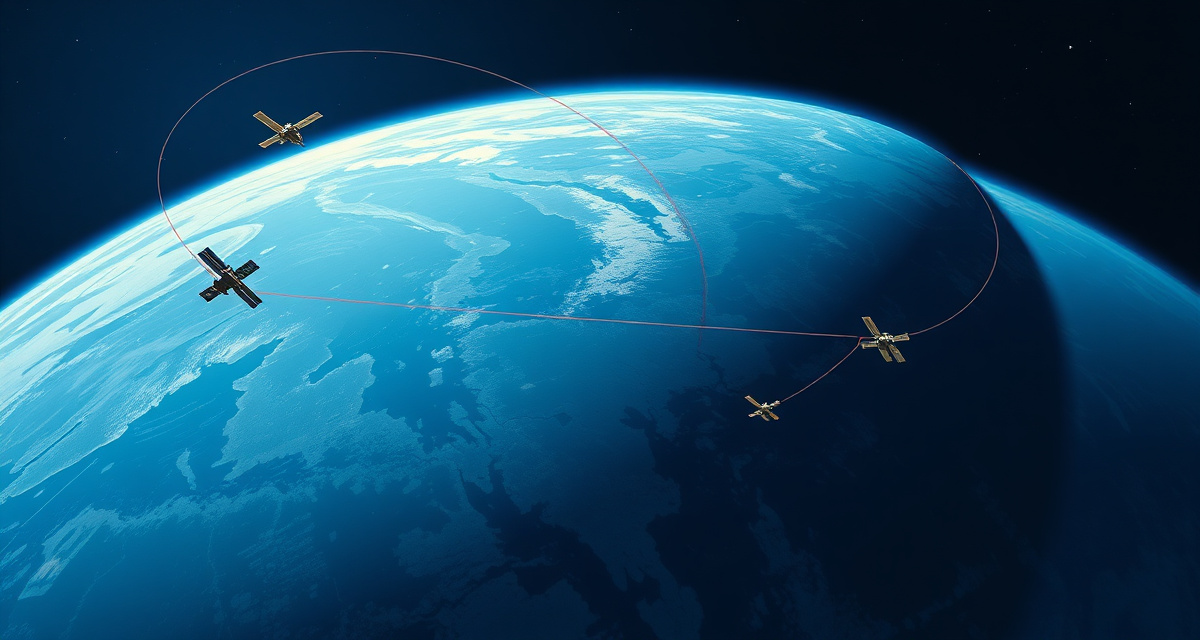
Studying starlings has given researchers mathematical tools that apply across biology, physics, and even engineering. Swarm robotics — the design of large groups of simple drones that coordinate without central control — borrows directly from this work.
What They Are Not Doing
A few common misreadings are worth correcting.
There is no leader. Scientists have looked carefully for dominant birds, and none are found. Every bird is essentially running the same behavioral program.
The flock is not doing math. No starling is computing vectors. The beauty of emergence is that it does not require sophistication at the individual level. Simple rules, thousands of times over, produce complex global behavior.
There is no collective consciousness. This is sometimes hinted at in popular writing, and it is not what the science shows. The flock's unity is a pattern, not a mind. It emerges from many local interactions without any central awareness of the whole.
Why They Do It
A separate biological question is why starlings flock at all. The prevailing answer involves several interacting pressures:
- Predator defense. A tight flock confuses raptors by making it hard to isolate a single target. Predators that target the confusion of a murmuration tend to miss more often than those stalking isolated birds.
- Social information. Roosting and traveling together gives starlings opportunities to follow successful foragers, learn feeding locations, and find mates.
- Thermoregulation. Huge communal roosts retain heat — important in winter.
Murmurations tend to appear most dramatically at dusk, just before the birds settle into their communal roost. The apparent "show" is, in biological terms, a choreography of safety: surveying the landing site, confounding any predators in the area, and allowing latecomers to join the group before everyone drops into the reeds.
The Lesson in the Sky
A murmuration looks like the work of a single mind. It is, in fact, the work of thousands of birds each doing a simple thing and paying attention to just a handful of neighbors. That is the point. The beauty is not that starlings are individually extraordinary, but that coordination of breathtaking elegance can arise from utterly ordinary local rules.
Complex order does not always require a commander. Sometimes it just requires that everyone watch their neighbors carefully.
This is a scientifically important insight and a quietly humbling one. The starlings are teaching a lesson many designers, economists, and engineers have slowly had to learn. A system does not need central intelligence to behave intelligently. What it needs is the right rules, faithfully followed, many times over.
The next time you see that dark cloud of birds fold and pour through an autumn sky, you are seeing one of nature's most elegant algorithms at work. Simple, local, leaderless — and more than the sum of its parts.