For the first half of Earth's history, breathing the air would have killed you. The atmosphere was a haze of nitrogen, methane, carbon dioxide, and water vapor, with essentially no free oxygen. The oceans were anoxic and chemically alien. Then, beginning around 2.4 billion years ago, oxygen began to accumulate in the atmosphere. Most of the planet's microbial life was poisoned. The world's first mass extinction was underway — caused not by an asteroid or a volcano, but by life itself.
This is the Great Oxidation Event, sometimes called the Oxygen Catastrophe. It is the largest environmental transformation in the history of the planet, and it made everything that came after it possible.
What Earth Looked Like Before
For roughly the first two billion years after Earth formed, the atmosphere contained almost no free O₂. Geological evidence is unambiguous on this point. Sedimentary rocks from this era contain banded iron formations — alternating layers of iron oxides and silica that could only form in oceans saturated with dissolved iron. Free oxygen would have rusted that iron out of the water immediately.
Ancient soils, too, lack the rusty-red staining of oxidized iron that would mark exposure to an oxygen-rich atmosphere. Detrital pyrite and uraninite — minerals that decompose in oxygen — survive intact in early Archean sedimentary rocks. The picture is consistent: Earth's early atmosphere was reducing, not oxidizing.
The life that filled this world was anaerobic. It harvested energy from chemistry — sulfur compounds, hydrogen, methane — but not from O₂. For these organisms, oxygen was not a resource but a corrosive toxin.
The Innovators
Then a small group of microbes invented something extraordinary: oxygenic photosynthesis. They learned to split water molecules using sunlight, harvesting the hydrogen for energy and releasing oxygen as a waste product.
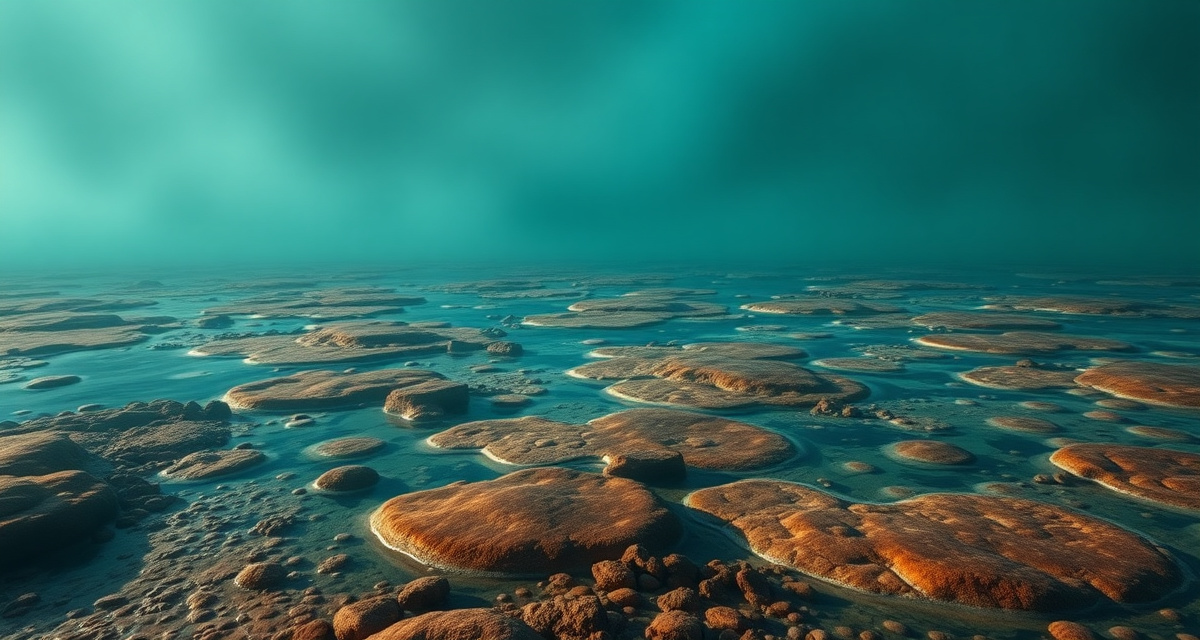
These were the cyanobacteria. The earliest robust evidence for them appears in stromatolites — layered microbial mats — dating back at least 2.7 billion years, though some lines of evidence push the origin earlier still. For hundreds of millions of years they spread quietly through the world's oceans, doing something no other organism on Earth could do.
What they were releasing into the water was, at first, harmless. Free oxygen reacted immediately with dissolved iron and other reduced compounds in the oceans, producing iron oxides that fell to the seafloor. This is the source of the banded iron formations — slow accumulation of cyanobacterial waste, captured in rock.
For something on the order of a billion years, the planet's oxygen sinks absorbed everything cyanobacteria produced. Then, beginning around 2.4 billion years ago, the sinks ran out.
The Tipping Point
The geological record marks the change with startling clarity. Banded iron formations decline. Red beds — sediments stained by oxidized iron exposed to atmosphere — appear. Ancient soils begin to show the chemical signatures of weathering by oxygen. Sulfur isotope ratios shift in patterns that reflect the dwindling of mass-independent fractionation processes that work only in low-oxygen atmospheres.
Atmospheric oxygen rose, by current estimates, from a vanishingly small concentration to perhaps 1–10% of modern levels — still far below today's 21%, but enough to fundamentally change the chemistry of the planet's surface. The atmosphere stopped being reducing and became oxidizing.
For most of the existing biosphere, this was a catastrophe. Oxygen reacts violently with the molecular machinery of anaerobic life. It generates reactive oxygen species — superoxide, hydroxyl radicals — that damage proteins, lipids, and DNA. The microbial world that had dominated Earth for over a billion years was, in evolutionary terms, suddenly exposed.
Many anaerobes went extinct. Others retreated to refuges where oxygen could not reach them — deep sediments, the guts of later animals, hot springs, hydrothermal vents. They are still there today. But the surface world they had ruled was no longer habitable to them.
The Snowball Connection
The oxygen rise had a second consequence that was nearly as dramatic. Methane is a powerful greenhouse gas, and the early atmosphere had contained a great deal of it — generated by methanogenic archaea, sustained by chemistry that does not survive the presence of free oxygen.
When oxygen levels rose, atmospheric methane dropped. The greenhouse effect weakened. Temperatures plunged.
The result was a sequence of Snowball Earth glaciations. The Huronian glaciation, lasting roughly from 2.4 to 2.1 billion years ago, may have covered much of the planet in ice — possibly even reaching the equator. Geological records of glacial deposits at low paleolatitudes are striking. The biological transformation reshaped the climate, and the climate reshaped life again.
What It Made Possible
For all the destruction, the rise of oxygen opened doors that anaerobic life had not been able to open.
Oxygen-based respiration is enormously more efficient than anaerobic metabolism. Burning glucose with oxygen yields roughly fifteen to twenty times the usable energy compared to fermentation. Organisms that learned to detoxify oxygen — and then to use it — had access to an energy budget no anaerobe could match.
This energy budget appears to have been the prerequisite for everything that followed. Eukaryotic cells, which are larger and more complex than bacteria, almost certainly required the energy economics of aerobic respiration. The evolutionary biologist Nick Lane has argued that the energy density problem is so severe that complex life could not have arisen any other way.
Eukaryotic cells appear in the fossil record around 1.6 to 1.8 billion years ago, well after the oxygenation event. Multicellular life follows much later. The Cambrian explosion of animal diversity — about 540 million years ago — coincides with another rise in atmospheric oxygen. Without the long preparatory work of cyanobacteria, none of this would have happened.
The Legacy
The atmosphere we breathe today — 78% nitrogen, 21% oxygen, with traces of everything else — is the inherited result of the Great Oxidation Event and a series of follow-on changes over the next two billion years. The free oxygen that lets you read this sentence exists because microbes invented water-splitting photosynthesis and then poisoned half their world for over a billion years until the chemistry stabilized.
It is a strange thing to contemplate. The single most consequential mass extinction in Earth's history was caused by photosynthesis — by life producing what other life could not survive. It killed many of the existing inhabitants and, in doing so, made room for the kind of life that would eventually include us.
Earth has had several catastrophes since. None reshaped the planet as deeply.