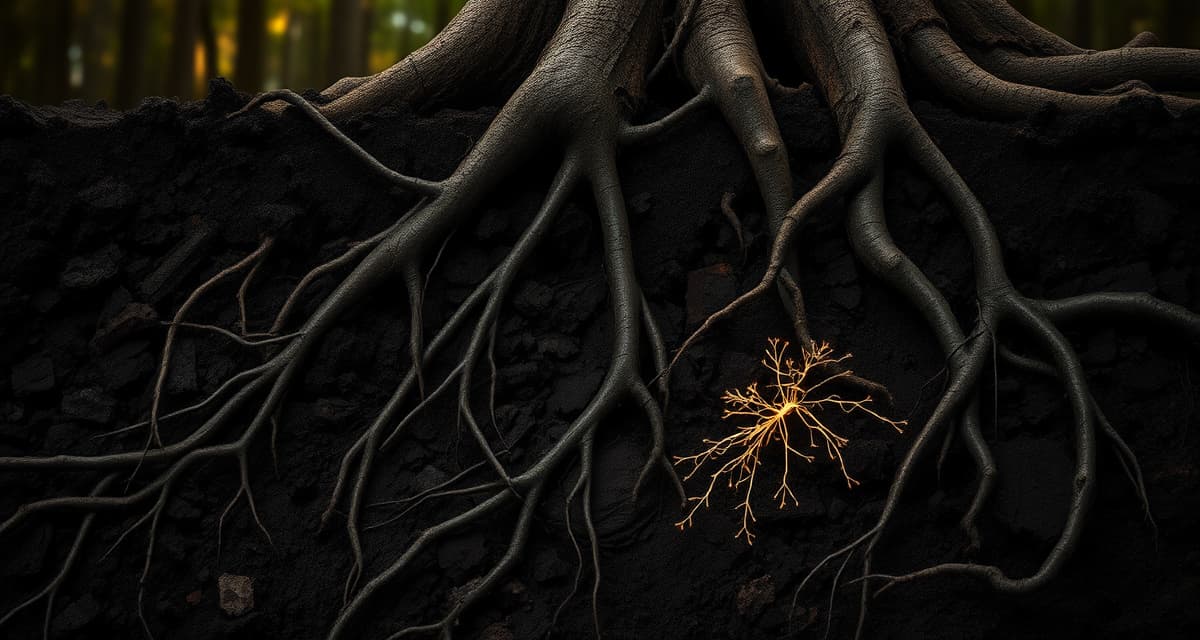
Walk into an old forest. Look down. What you see — the leaf litter, the duff, the tangled roots — is only the surface. Beneath your feet, through every cubic inch of soil, runs a vast and ancient biological network that predates trees themselves. Most of the plants in that forest could not survive without it. Most of us, until recently, did not know it existed.
Mycorrhizal networks are partnerships between fungi and plant roots. They are so old and so widespread that roughly 90% of all land plant species participate in them. And in the last three decades, careful experimental work has revealed that these networks do something astonishing: they move water, nutrients, and chemical signals between individual plants — sometimes across species lines — in ways that change how we think about plant life, ecosystems, and even the boundaries of an "individual."
The Partnership at the Root
A mycorrhiza (literally "fungus-root") is a symbiosis. The fungus wraps its fine, thread-like hyphae around — or inside — the cells of a plant root. In exchange for sugars produced by the plant through photosynthesis, the fungus delivers water and mineral nutrients — especially phosphorus and nitrogen — that the plant would struggle to obtain on its own. The fungus's network of hyphae is far finer than any root, and it can penetrate the soil's smallest pores.
Two main types exist. Arbuscular mycorrhizal fungi form intricate branched structures inside plant root cells, and they associate with the majority of plant species, including most crops. Ectomycorrhizal fungi wrap around root tips without penetrating cells, and they form the main partnerships with trees like pine, oak, and birch. The partnership is at least 400 million years old — as old as land plants themselves — and by some accounts, plants could not have colonized land without it.
The "Wood Wide Web"
In the mid-1990s, Canadian ecologist Suzanne Simard published a landmark paper in Nature showing that Douglas fir and paper birch seedlings were exchanging carbon underground through a shared fungal network. Using radioactive tracers, she could watch carbon flow from one species to another. The flow direction shifted with the seasons: birch fed fir in shaded summer months, fir fed birch in spring before the birch leafed out.
Later work has extended the picture. Water and defensive chemical signals can also move through the network. Mature trees in many forest ecosystems appear to preferentially support their own seedlings and closely related individuals. The popular press dubbed the system the "wood wide web," a term coined in the journal Nature's own news coverage.
A tree is not an isolated organism competing against its neighbors. In many forests, it is a node in a shared network that makes cooperation and competition much more subtle than the old picture allowed.
What the Evidence Actually Shows
Popular writing about mycorrhizal networks has sometimes outrun the science. It is worth being careful about what is well-established and what is still debated.
Well-established. Mycorrhizal partnerships dramatically increase plant access to water and nutrients. Fungal networks can connect multiple plants simultaneously. Carbon, water, and some chemical signals can move through those networks between plants.
More contested. The extent to which "mother trees" deliberately nurture their offspring through the network is an active scientific debate. A 2023 review by Justine Karst and colleagues argued that some well-known claims — for example, that mature trees preferentially send carbon to kin seedlings in forests — are not yet as rigorously supported as public accounts suggest. The researchers were not denying the existence of networks; they were asking for more careful experimental work before strong conclusions are drawn.
This is how healthy science looks. A dramatic hypothesis emerges, captures public imagination, and then gets scrutinized. Some of it holds, some gets refined, some gets rejected. The current consensus is that mycorrhizal networks are real, important, and more widespread than we thought; whether they amount to a "forest social network" with preferences and intentions is not yet settled.
Why It Matters Beyond the Forest
Mycorrhizal networks are not just an ecological curiosity. They have practical implications.
Agriculture. Industrial farming practices — heavy tillage, synthetic phosphorus fertilizer, fungicides — tend to disrupt mycorrhizal associations. When mycorrhizal networks are healthy, crops are often more drought-resistant, more efficient at taking up phosphorus, and less vulnerable to certain soil pathogens. A growing body of regenerative agriculture research is trying to work with, rather than against, these networks.
Climate. Mycorrhizal fungi are a significant carbon sink. A 2023 study in Current Biology estimated that mycorrhizal fungi receive about 13 billion tons of carbon dioxide equivalent from plants globally per year, storing it in fungal biomass and soil organic matter. That is roughly a third of annual fossil fuel emissions. Protecting soil microbial life may be as important to climate stability as protecting forests.
Philosophy of biology. What is an individual? The lines between plant and fungus, between neighbor and self, between competition and cooperation, all become blurrier when you take the network seriously. Biologist Lynn Margulis spent her career arguing that symbiosis is a more fundamental force in evolution than most biologists acknowledged. Mycorrhizal networks are one of her most vivid examples.
The Quiet Economy
There is a gentle lesson in this underground economy. The plants you admire are not standing alone. They are in relationships older than they are, with organisms you never see, exchanging what each has for what each lacks. The forest is not a collection of trees. It is a system in which trees, fungi, microbes, and soil together do something no one part could do.
The next time you walk through old woods, notice what you can't see. A few inches below your boot tips, hyphae finer than hair are threading through the soil, moving water toward a dry root, carrying sugar to a hungry fungus, carrying a warning from one species to another. It has been going on for four hundred million years. We are just starting to learn the grammar of what it is saying.