In 1915, Albert Einstein published his general theory of relativity — a description of gravity not as a force but as the curvature of spacetime caused by mass. A year later, Karl Schwarzschild, working from the Eastern Front in World War I, solved Einstein's field equations and found something strange: at a certain critical radius (now called the Schwarzschild radius), the mathematics predicted that spacetime curvature would become infinite.
Einstein didn't believe this was physical. He thought the singularity was a mathematical artifact — a symptom of the equations being pushed beyond their domain of applicability.
He was wrong. Black holes are real.
What a Black Hole Is
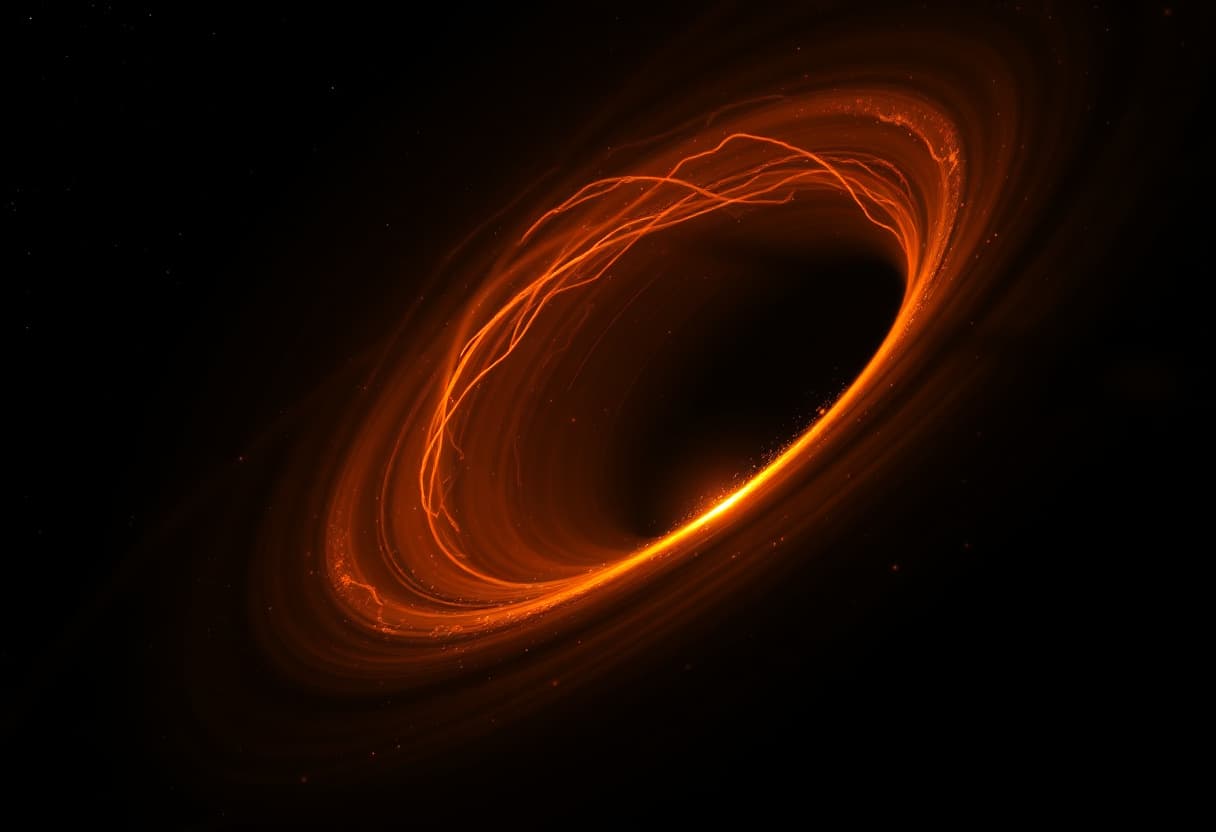
A black hole is a region of spacetime from which nothing — not matter, not light, not information — can escape once it crosses the event horizon. The event horizon is not a physical surface. There's nothing there to bump into. It is a boundary in spacetime defined by the geometry: on this side, paths exist that lead out; on the other side, all paths lead inward.
The gravitational field becomes infinite at the singularity — a point (or ring, for rotating black holes) at the center where density is infinite and the known laws of physics break down. What actually happens at the singularity is unknown; the math stops being reliable there. A complete theory of quantum gravity, which physicists don't yet have, would be needed to describe it.
Stellar-mass black holes form when massive stars (roughly 20+ solar masses) exhaust their nuclear fuel and collapse. The outward radiation pressure that counteracted gravity disappears, and the core collapses catastrophically into a black hole, typically accompanied by a supernova.
Supermassive black holes — millions to billions of solar masses — sit at the centers of most large galaxies, including the Milky Way. How they formed remains an active research question.
The Evidence
Black holes were theoretical for decades. Direct evidence accumulated gradually.
X-ray binaries: When a black hole has a stellar companion, it can draw material off the companion star into an accretion disk. The material spirals inward, heats to millions of degrees, and emits X-rays — detectable from Earth. Dozens of such systems have been identified.
Gravitational waves: In 2015, the LIGO interferometers detected gravitational waves — ripples in spacetime — from the merger of two black holes 1.3 billion light-years away. The signal matched theoretical predictions precisely. Since then, dozens of merger events have been detected.
Direct imaging: In 2019, the Event Horizon Telescope collaboration published the first image of a black hole's shadow — the dark region surrounded by the bright glow of heated material around M87*, a supermassive black hole 6.5 billion solar masses in a galaxy 55 million light-years away. In 2022, the same team published an image of Sagittarius A*, the supermassive black hole at the center of the Milky Way.
The image of M87* matched theoretical predictions to a degree that left little room for doubt. Black holes went from mathematical prediction to observed object.
What Happens If You Fall In
For a large enough black hole, the experience of crossing the event horizon is anticlimactic — at least initially. The tidal forces (differences in gravitational pull between your head and your feet) are manageable at a supermassive black hole's horizon. You cross without noticing anything dramatic.
What you cannot do is turn around. Your future is now inside the black hole. All physical paths lead toward the singularity, and the time to reach it is finite and short — perhaps seconds for a stellar-mass black hole, hours for a supermassive one.
From outside, something different is observed. Gravitational time dilation means that an outside observer sees the infalling object slow down asymptotically as it approaches the horizon, becoming increasingly redshifted and dimming to invisibility. The object appears to freeze, never quite crossing. This is not illusion — both descriptions are correct in their respective reference frames.
The Information Paradox
Stephen Hawking showed in 1974 that black holes emit a faint thermal radiation (Hawking radiation) due to quantum effects near the event horizon, and will eventually evaporate. This creates a deep problem: all the information about what fell into the black hole — the quantum states of every particle — appears to be destroyed. But quantum mechanics forbids the destruction of information.
The information paradox is one of the central unsolved problems at the intersection of general relativity and quantum mechanics. It has generated decades of theoretical work. The current best candidate resolution involves the concept of "black hole complementarity" and the quantum properties of the horizon itself, but no consensus has been reached.
What this tells us, at minimum, is that black holes are not just extreme gravity machines. They are windows into the regime where our two most successful physical theories — general relativity and quantum mechanics — are in fundamental conflict.
¹ Stephen Hawking — A Brief History of Time (1988), Bantam Books ² Kip Thorne — Black Holes and Time Warps (1994), W.W. Norton ³ Event Horizon Telescope Collaboration — "First M87 Event Horizon Telescope Results" (2019), The Astrophysical Journal Letters