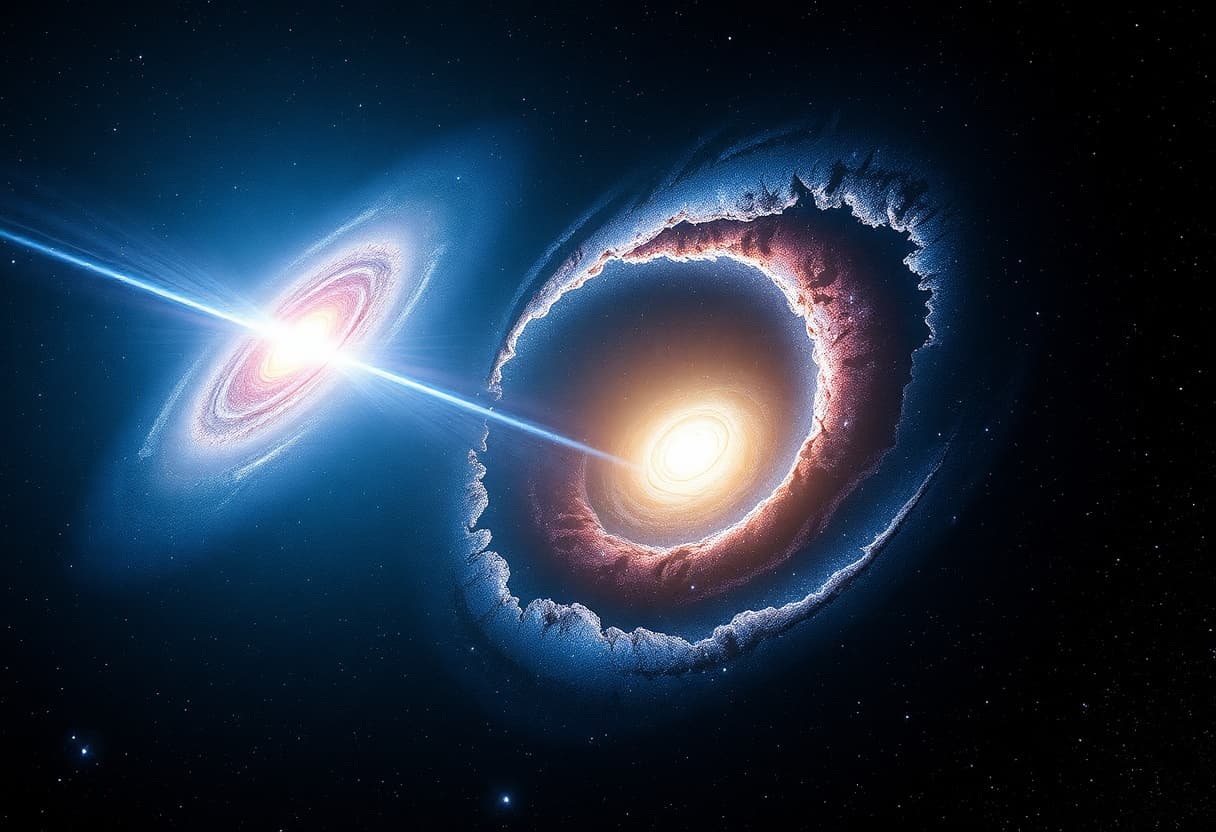
Light does not always travel in a straight line. Near a massive object — a planet, a star, a black hole — the geometry of space itself curves, and light follows that curvature. The result is one of the most striking phenomena in observational astronomy: gravitational lensing, in which a massive object bends the light from a more distant source and produces distorted, magnified, or even multiple images of it.
It was predicted by Einstein's general theory of relativity in 1915. ¹ And when Arthur Eddington's 1919 solar eclipse expedition confirmed the bending of starlight around the sun, it launched both a scientific revolution and the first great celebrity physicist of the modern era. But the story of gravitational lensing goes far deeper than that confirmation — it has since become one of astronomy's most powerful investigative tools.
How It Works
In Newtonian gravity, a massive object deflects the path of any other object moving near it — including, as Einstein also showed, light. But in general relativity, the deeper explanation is not a force acting on light. It is a curvature of spacetime caused by mass, and light simply follows the most natural path through that curved geometry.
The amount of bending depends on the mass of the lensing object and the distance between source, lens, and observer. For most everyday masses, the effect is negligibly small. But near stars, galaxies, and galaxy clusters, it becomes significant and measurable.
When the source, lens, and observer are nearly perfectly aligned, something extraordinary happens. Light from the source travels around all sides of the lensing mass simultaneously, producing a complete ring of light around the lens — known as an Einstein ring. These are rare and geometrically beautiful, and they have been imaged directly by telescopes including the Hubble Space Telescope. ²
Three Regimes
Gravitational lensing operates at three scales, each with distinct astronomical uses.
Strong lensing occurs when the lens is very massive and the alignment is favorable. It produces multiple distorted images, arcs, and Einstein rings. Strong lensing around galaxy clusters can produce dozens of distorted images of background galaxies, some appearing several times simultaneously. These configurations are striking in imagery, and they enable measurements that would otherwise be impossible.
Weak lensing is far more subtle — the distortion of background galaxy shapes by mass along the line of sight is small enough that no individual galaxy shows obvious lensing. But across thousands or millions of background galaxies, statistical analysis reveals the coherent pattern of distortion caused by intervening mass. This technique has become one of the primary tools for mapping the large-scale distribution of matter in the universe.
Microlensing is the smallest scale — a single compact object (a star, a rogue planet, or a black hole) lensing a more distant star directly behind it. The distant star temporarily brightens as the lens passes in front of it, producing a distinctive light curve. Microlensing surveys have been used to detect exoplanets, constrain the abundance of compact dark objects, and look for free-floating planetary-mass objects in our galaxy. ³
Seeing the Invisible
Perhaps the most powerful application of gravitational lensing is as a probe of dark matter — the hypothetical mass that does not emit or absorb light but exerts gravitational influence.
Dark matter cannot be seen directly. But it bends light just as visible matter does, and weak lensing surveys can map its distribution across the sky without any assumption about what it is or what it looks like. The results have been striking: the dark matter distribution does not simply trace the luminous galaxies — it forms vast, interconnected filaments stretching between galaxy clusters, creating what cosmologists call the cosmic web. ⁴
The Bullet Cluster, a pair of colliding galaxy clusters, provided particularly compelling evidence. When clusters collide, the gas (which is most of the ordinary matter) experiences friction and slows down. But lensing maps showed that the majority of the mass — whatever it was — passed through the collision without slowing, separating spatially from the gas. This behavior is exactly what you would expect from dark matter that interacts only gravitationally, and very difficult to explain otherwise.
Lensing as a Telescope
There is a more immediate practical use of gravitational lensing that NASA and ESA have begun to exploit systematically. Massive galaxy clusters, acting as natural lenses, can magnify very distant, very faint galaxies that would otherwise be undetectable by any telescope currently in existence.
The Hubble Frontier Fields program deliberately observed six massive galaxy clusters precisely for this reason — using the clusters as cosmic magnifying glasses to see galaxies from when the universe was less than a billion years old. ⁵ The James Webb Space Telescope has continued this strategy, producing some of its most distant observations through cluster lenses.
In this sense, the universe provides astronomers with equipment that no engineering program could build: gravitational lenses that amplify the faintest light from the furthest reaches of time.
The Elegance of the Method
What is perhaps most remarkable about gravitational lensing as a scientific tool is what it reveals about the relationship between observation and theory. The effect was predicted mathematically before it was ever observed. The observation then confirmed the prediction with extraordinary precision. And the confirmed prediction has since enabled discoveries — of dark matter structure, of distant galaxies, of free-floating planets — that the original theorists could not have imagined.
This is science operating at its most elegant: a single theoretical insight, confirmed by a solar eclipse in 1919, still unfolding into new knowledge a century later.
Sources
¹ Albert Einstein — "Die Grundlage der allgemeinen Relativitätstheorie," Annalen der Physik (1916) ² NASA Hubblesite — Einstein Rings and Gravitational Lensing ³ Andrew Gould & Abraham Loeb — "Discovering Planetary Systems Through Gravitational Microlenses," Astrophysical Journal (1992) ⁴ Douglas Clowe et al. — "A Direct Empirical Proof of the Existence of Dark Matter," Astrophysical Journal Letters (2006) ⁵ NASA Hubble Frontier Fields Program