Somewhere between 4 and 4.5 billion years ago, a relatively undistinguished star in an outer spiral arm of the Milky Way began forming from a rotating cloud of gas and dust. Around it, in the disk of leftover material, small clumps stuck together, grew, and eventually became planets. One of those planets ended up in a narrow band around that star — close enough to receive warmth, far enough not to be scorched — and somewhere on its surface, in conditions we still don't fully understand, something remarkable happened: chemistry became biology.
The origin of life is one of the deepest open questions in all of science. Not just scientifically but philosophically: it sits at the intersection of chemistry, physics, geology, and — for many people — theology. What we do understand, and what remains genuinely contested, is worth examining carefully.
The Chemical Prerequisites
Life as we know it requires a set of chemical capabilities: self-replication (the ability to copy information), metabolism (the ability to capture and use energy), and compartmentalization (some kind of boundary that separates "inside" from "outside"). How and in what order these three properties emerged is the central puzzle.
The RNA World hypothesis is currently the most widely supported framework for understanding the origin of genetic information.¹ RNA is a molecule that can do two things simultaneously: it can carry information (like DNA) and catalyze chemical reactions (like proteins). This dual capacity makes RNA a compelling candidate for the original self-replicating molecule — a molecule that could both encode instructions and carry them out.
Laboratory work by Jack Szostak and colleagues has demonstrated that simple RNA molecules can copy themselves under certain conditions, and that fatty acid membranes (simpler precursors to the lipid bilayers of modern cells) spontaneously form closed vesicles that can grow, divide, and selectively absorb molecules from their environment.² These are not living cells, but they share several fundamental properties with life.
Where Did It Happen?
The where question has generated genuine scientific controversy and no settled consensus. Two main environments have been most seriously proposed:
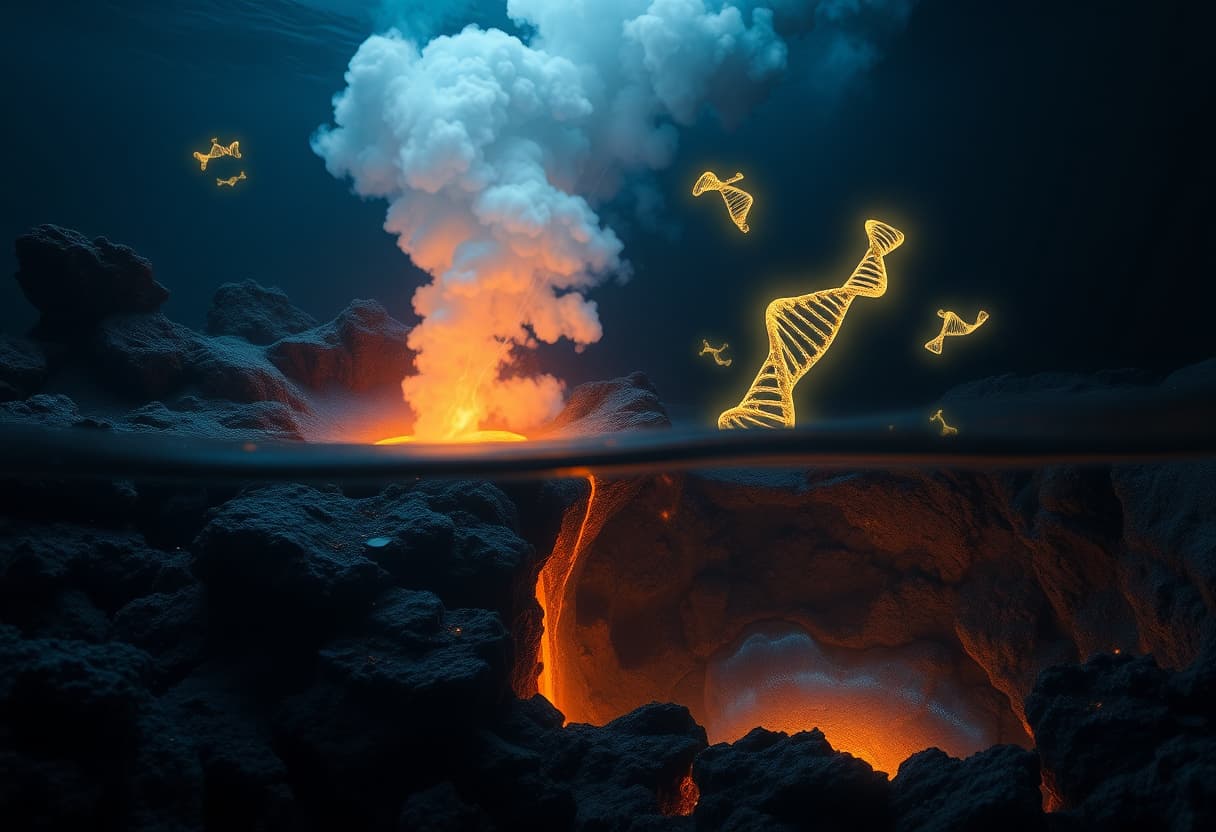
Hydrothermal vents — specifically the alkaline, off-axis vents known as "white smokers" (like the Lost City vent field in the Atlantic) — offer chemical gradients, mineral surfaces that could have acted as early catalysts, and continuous energy flow.³ The geochemist Mike Russell and biologist Nick Lane have argued that the proton gradients found in these vents are so similar to the proton gradients cells use today that the resemblance is not coincidental.
Surface pools — shallow, warm pools of water that could concentrate and evaporate chemicals with cycles of wet and dry — represent the competing view. Darwin's famous "warm little pond" has been given new life by researchers including John Sutherland, whose work has shown that a surprisingly wide range of the basic chemical building blocks of life — including nucleotides, amino acids, and lipid precursors — can be synthesized together from simple compounds under plausible early-Earth conditions.⁴
Both scenarios have genuine evidence behind them, and both remain live hypotheses.
The Information Problem
Of all the obstacles to understanding the origin of life, the information problem is the most philosophically provocative. Even a simple bacterium contains an instruction set of astonishing complexity — thousands of genes encoding the proteins that manage virtually every function of the cell. Where did that information come from?
The standard evolutionary answer is gradualism: simple self-replicating systems, under selection pressure, accumulated complexity over hundreds of millions of years. This is plausible in principle. The challenge is that even the simplest known self-replicating systems today are far more complex than anything laboratory experiments have produced from scratch.
The gap between chemistry and biology is not just a matter of scale. It is a problem of organized information.
This is a genuine scientific puzzle, not a gap artificially created to smuggle in a supernatural explanation. The honest position is that we don't fully understand how the first informational system crossed the threshold from chemistry to self-sustaining biology. Current research is narrowing that gap — but it has not closed it.
What We Know and What Remains Open
The scientific consensus includes several confident conclusions: the Earth is approximately 4.5 billion years old; evidence of microbial life appears in the rock record by at least 3.5 billion years ago and possibly earlier; the basic chemical building blocks of life (amino acids, nucleobases, sugars) form readily under a wide range of conditions and have been found in meteorites, confirming that prebiotic chemistry is not rare.
What remains genuinely open: the specific pathway from chemistry to the first self-replicating system; the location (vents, pools, or elsewhere); whether life originated once or multiple times; and whether life on Earth is an expected outcome of planetary chemistry or a staggeringly improbable accident.
The origin of life is a frontier question — meaning it is one where the honest answer to "do we know?" is "not fully, but here is what we do know and here is where the live debate currently sits." That kind of intellectual honesty is itself one of science's most valuable contributions.
Sources
¹ Walter Gilbert — The RNA World, Nature (1986) ² Jack Szostak, David Bartel, Pierre Luigi Luisi — Synthesizing Life, Nature (2001) ³ Nick Lane and Mike Russell — Death Is Not the End: Hydrothermal Vents and the Origin of Life, Journal of Cosmology (2010) ⁴ John Sutherland — The Origin of Life — Out of the Blue, Angewandte Chemie (2016)