The Ground Beneath Your Feet Is Moving
Right now, as you read this, the continent you are standing on is drifting. North America moves roughly 2.5 centimeters per year — about the speed your fingernails grow. The Atlantic Ocean is widening. The Pacific is shrinking. The Himalayas are still rising, pushed upward by the collision of India and Eurasia that began about 50 million years ago.
Plate tectonics is the unifying theory of Earth science. It explains earthquakes, volcanoes, mountain ranges, ocean basins, and the distribution of fossils across continents. It is one of the great intellectual achievements of the 20th century — and it took decades of resistance before the scientific community accepted it.
Continental Drift: The Idea That Came Too Early
In 1912, German meteorologist Alfred Wegener proposed that the continents had once been joined in a single landmass he called Pangaea (Greek for "all land"). His evidence was compelling: the coastlines of Africa and South America fit together like puzzle pieces. Identical fossils of the reptile Mesosaurus appeared on both continents, separated by thousands of miles of ocean. Geological formations in Scotland matched formations in Appalachia.
But Wegener could not explain how continents moved. His proposed mechanism — that continents plowed through the ocean floor like ships through water — was physically implausible, and geophysicists rejected it. Wegener died on an expedition to Greenland in 1930, his theory largely dismissed.
The Seafloor Holds the Answer
The key evidence came from an unexpected place: the bottom of the ocean.
In the 1950s and 1960s, oceanographer Marie Tharp and her colleague Bruce Heezen mapped the Atlantic seafloor and discovered the Mid-Atlantic Ridge — a continuous underwater mountain chain running the entire length of the Atlantic. At its center was a deep rift valley, suggesting the seafloor was splitting apart.
In 1962, geologist Harry Hess proposed seafloor spreading: new oceanic crust forms at mid-ocean ridges as magma rises from the mantle, then spreads outward in both directions. Old crust is eventually recycled back into the mantle at deep ocean trenches — a process called subduction.
The confirmation came from magnetic data. When molten rock cools, iron minerals align with Earth's magnetic field, which periodically reverses. Frederick Vine and Drummond Matthews (1963) showed that the seafloor displayed symmetrical stripes of normal and reversed magnetism on either side of mid-ocean ridges — exactly what you would expect if new crust were continuously forming and spreading outward. This was the smoking gun.
How Plate Tectonics Works
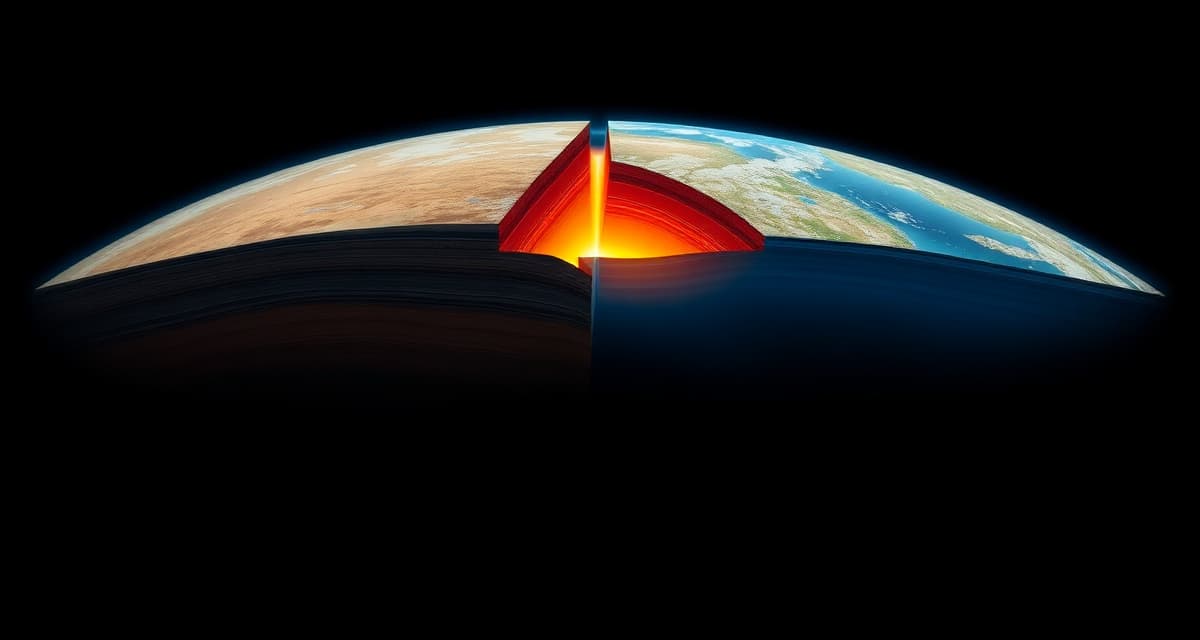
Earth's outer shell — the lithosphere — is broken into roughly 15 major plates and several smaller ones. These rigid plates float on the asthenosphere, a layer of hot, slowly flowing rock in the upper mantle.
Three types of plate boundaries drive geological activity:
Divergent boundaries — where plates move apart. Magma rises to fill the gap, creating new crust. The Mid-Atlantic Ridge is a divergent boundary. Iceland sits directly on top of one, which is why it has so much volcanic activity.
Convergent boundaries — where plates collide. When oceanic crust meets continental crust, the denser oceanic plate dives beneath the lighter continental plate (subduction). This produces deep ocean trenches, volcanic arcs, and earthquakes. The Andes mountain chain and the "Ring of Fire" around the Pacific are products of convergent boundaries. When two continental plates collide, neither subducts easily — instead, the crust crumples and folds upward. This is how the Himalayas formed and continue to grow.
Transform boundaries — where plates slide past each other horizontally. The San Andreas Fault in California is a transform boundary between the Pacific and North American plates. These boundaries produce earthquakes but little volcanic activity.
What Drives the Plates
The engine beneath plate tectonics is mantle convection — the slow circulation of hot rock in Earth's interior. Heat from the core and from radioactive decay in the mantle creates convection currents: hot material rises, spreads laterally, cools, and sinks. These currents exert drag on the overlying plates.
But convection alone does not fully explain plate motion. Two additional forces play important roles:
Ridge push — the elevated position of mid-ocean ridges creates a gravitational force that pushes plates away from the ridge.
Slab pull — at subduction zones, the dense, cold edge of an oceanic plate sinks into the mantle, pulling the rest of the plate behind it. Most geophysicists now consider slab pull the dominant driving force.
Plate Tectonics and Life
The movement of continents has profoundly shaped the history of life on Earth. When Pangaea broke apart, populations were isolated on separate continents, driving independent evolutionary paths. Australia's unique marsupial fauna exists because the continent separated from Gondwana before placental mammals could dominate.
Plate tectonics also regulates Earth's carbon cycle. Volcanic activity at plate boundaries releases carbon dioxide into the atmosphere, while weathering of exposed rock and subduction of carbonate sediments remove it. Over geological timescales, this tectonic thermostat has helped keep Earth's climate within the range that supports liquid water — and therefore life.
A Theory Worth Understanding
Plate tectonics is one of those rare scientific theories that is both simple in concept and staggering in scope. It connects the earthquake you feel in California to the volcano erupting in Indonesia to the fossil you find in Antarctica. It explains why the world looks the way it does — and why it will look different in another hundred million years.
The ground beneath your feet is not solid in the way you imagine. It is a thin, fractured shell riding on a sea of slowly churning rock. And that motion, imperceptible in a human lifetime, has built and destroyed entire worlds.