In 1982, a materials scientist named Dan Shechtman looked through an electron microscope at an aluminum-manganese alloy he had rapidly cooled and saw something that was supposed to be impossible. The diffraction pattern — a map of how the material scatters an electron beam — showed a tenfold rotational symmetry. According to everything crystallographers knew, tenfold symmetry could not exist in a crystal. Crystals are periodic: their atoms repeat in a regular pattern, like tiles on a floor. And as mathematicians had proven long ago, you cannot tile a plane with tenfold symmetry. Only two-, three-, four-, and sixfold symmetries are compatible with periodicity.
Shechtman checked his results. He checked them again. He showed them to colleagues. He was told he was wrong. One colleague reportedly said, "Danny, this is not possible. Go read a textbook." Linus Pauling, a double Nobel laureate and one of the most famous scientists in the world, dismissed the finding publicly: "There is no such thing as quasicrystals, only quasi-scientists."
Shechtman was right. In 2011, he received the Nobel Prize in Chemistry for his discovery.
What Makes a Crystal a Crystal?
To understand why quasicrystals are so strange, you need to understand what crystallography assumed for over a century.
A crystal is a solid whose atoms are arranged in a pattern that repeats periodically in three dimensions. Think of a wallpaper pattern: a single motif — called a unit cell — repeats over and over in every direction. This periodicity is what gives crystals their sharp edges, flat faces, and distinctive diffraction patterns.
The mathematical constraint is strict. When you tile a flat surface with identical shapes that repeat periodically, only certain rotational symmetries are possible: 2-fold, 3-fold, 4-fold, and 6-fold. You can tile a floor with squares (4-fold), equilateral triangles (3-fold), or regular hexagons (6-fold). But you cannot tile a floor with regular pentagons. They leave gaps. This is why 5-fold (and 10-fold) symmetry was considered a crystallographic impossibility.
Shechtman's diffraction pattern showed 10-fold symmetry — crisp, clean spots arranged with a precision that could only come from a highly ordered structure. But the structure could not be periodic.
Aperiodic Order
The resolution of the paradox lies in a concept that mathematicians had been exploring for decades before Shechtman's discovery: aperiodic tiling.
In the 1960s, mathematician Robert Berger showed that it is possible to tile a plane with a set of shapes that covers the surface completely — no gaps, no overlaps — yet never repeats. The pattern has long-range order (it follows rules) but no translational periodicity (no motif ever repeats in a simple, regular way).
In the 1970s, physicist Roger Penrose discovered a particularly elegant aperiodic tiling using just two shapes — now known as Penrose tiles. These fat and thin rhombuses, when placed according to specific matching rules, produce a pattern with fivefold symmetry that extends infinitely without ever repeating. The pattern is ordered — you can see the symmetry clearly — but if you slide the whole pattern in any direction, it never maps perfectly onto itself.
Penrose tilings were considered a beautiful mathematical curiosity. Then Shechtman found the same kind of order in a real material.
The Structure of Quasicrystals
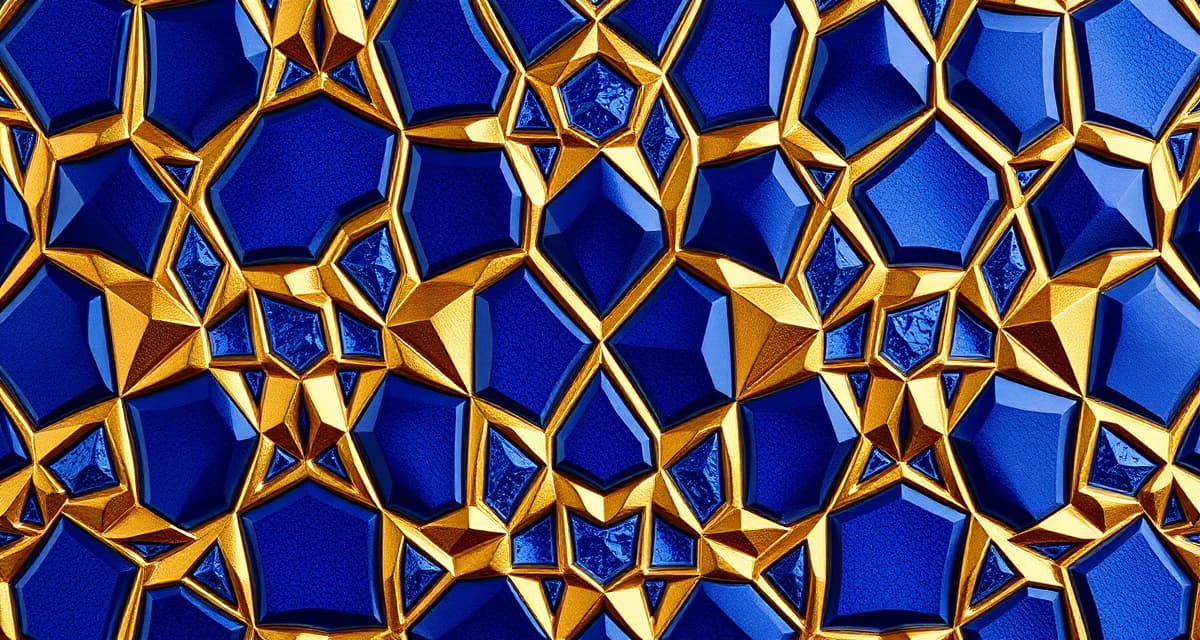
Quasicrystals are solids with long-range aperiodic order. Their atoms are arranged in a highly organized fashion — producing sharp, clear diffraction spots just like ordinary crystals — but the arrangement never repeats periodically. They occupy a strange middle ground between the perfect order of crystals and the disorder of amorphous materials like glass.
The mathematical description of quasicrystals involves a remarkable trick. While a quasicrystalline pattern is aperiodic in three dimensions, it can be understood as a projection of a periodic structure in a higher-dimensional space. A Penrose tiling, for example, can be generated by slicing a regular five-dimensional cubic lattice at an irrational angle and projecting the result down to two dimensions. The five-dimensional lattice is perfectly periodic. Its shadow in two dimensions is not.
This is not just an abstract mathematical device. The diffraction patterns of real quasicrystals can be indexed using higher-dimensional crystallography, and the match is precise. The mathematics predated the physics by years — the framework was ready and waiting when Shechtman's discovery needed it.
Unusual Properties
Quasicrystals have physical properties that differ markedly from their crystalline counterparts. Many metallic quasicrystals are poor conductors of electricity and heat — the opposite of what you'd expect from a metal. They tend to be hard and brittle. Their surfaces have unusually low friction. And some exhibit a property called low surface energy, which means other substances don't stick to them easily.
These properties have led to practical applications. Quasicrystalline coatings have been used in non-stick frying pans (Sitram's Cybernox line), surgical instruments, and hardening treatments for steel. Researchers have explored their potential as thermal barrier coatings, hydrogen storage materials, and catalysts.
Natural Quasicrystals
For decades, quasicrystals were known only from laboratory synthesis. Then, in 2009, Luca Bindi and Paul Steinhardt reported the first natural quasicrystal — found in a meteorite sample from the Khatyrka region of eastern Russia. The mineral, named icosahedrite, had the composition Al₆₃Cu₂₄Fe₁₃ and displayed icosahedral symmetry.
Steinhardt, a theoretical physicist at Princeton who had predicted the existence of quasicrystals independently of Shechtman's experimental discovery, organized an expedition to Kamchatka in 2011 to find the source. The team recovered additional samples from the meteorite, confirming that quasicrystals can form naturally — in this case, during the high-pressure collisions of asteroids in the early solar system, roughly 4.5 billion years ago.
The discovery suggested that the conditions for quasicrystal formation are not exotic laboratory accidents but can arise through natural processes — and that these structures may be far more common in the universe than anyone suspected.
What They Teach Us
Quasicrystals forced a redefinition of what a crystal is. In 1992, the International Union of Crystallography changed its official definition of a crystal from a structure with periodic atomic arrangement to any solid with "essentially discrete diffraction." This was not a minor semantic adjustment. It was an acknowledgment that nature is more inventive than our categories.
More broadly, quasicrystals are a reminder that the boundary between order and disorder is not as clean as we often assume. The universe permits forms of organization that are neither random nor repetitive — patterns that follow rules without ever settling into routine. It is a strange and beautiful kind of order, and it was hiding in plain sight until a stubborn scientist trusted his microscope over his textbook.